

Series 1 of 3: The Agentic Commerce Playbook for Small Business
By Ryan Cunningham, Co-Founder, AI Strategy and E-commerce, Ready, Plan, Grow!
Let’s cut the BS. The way people buy is changing forever. Right now.
Forget everything you think you know about SEO, social media marketing, and customer acquisition.

A new kind of customer has entered the chat, and it’s not human. It’s an AI agent. A piece of code that your customers are increasingly using to buy everything from running shoes to supplements to home goods.
And if your online store isn’t ready for it, you’re about to become invisible. Not tomorrow. Not next year. Now.
AI Agents Purchasing Online Not Sci-Fi
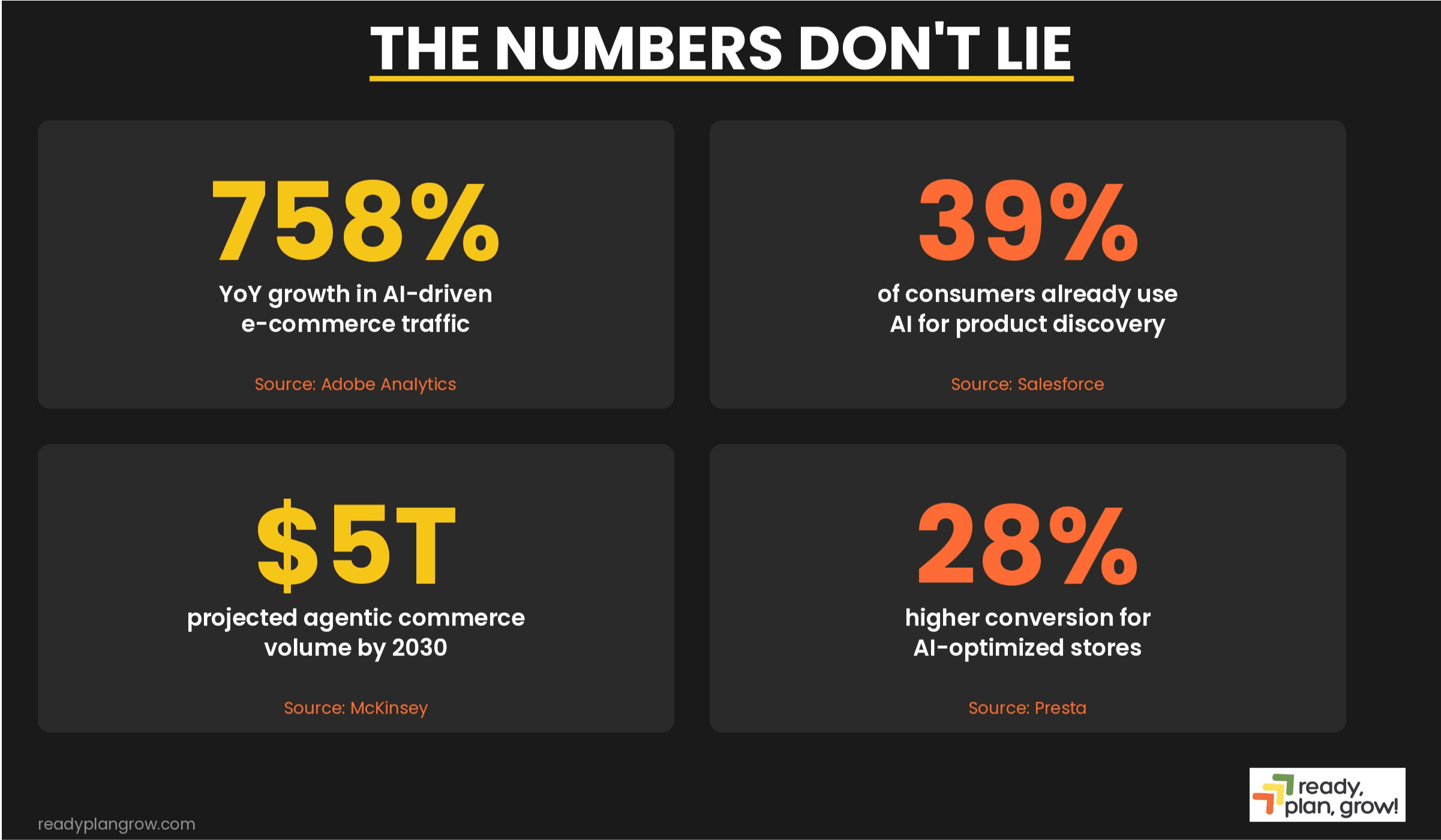
This isn’t some far-off, futuristic prediction. AI-driven e-commerce traffic grew 758% year-over-year during the 2025 holiday season (Adobe Analytics). On Black Friday 2025 alone, AI-driven traffic to US retail sites surged 805% (Salesforce).
This is the biggest structural shift in e-commerce since the smartphone, and the vast majority of small businesses are completely unprepared. AI agents purchasing online with their own wallets is here folks!
The Wake-Up Call: What the Numbers Say
Here are the stats you need to know. These are not projections. These are happening right now:
758% YoY increase in AI-driven e-commerce traffic during Holiday 2025 (Adobe Analytics)
39% of consumers already use AI for product discovery (Salesforce)
$5 trillion projected global agentic commerce volume by 2030 (McKinsey)
28% higher conversion rate for AI-optimized stores vs. traditional search (Presta)
23% of Americans have already bought something using AI (Morgan Stanley)
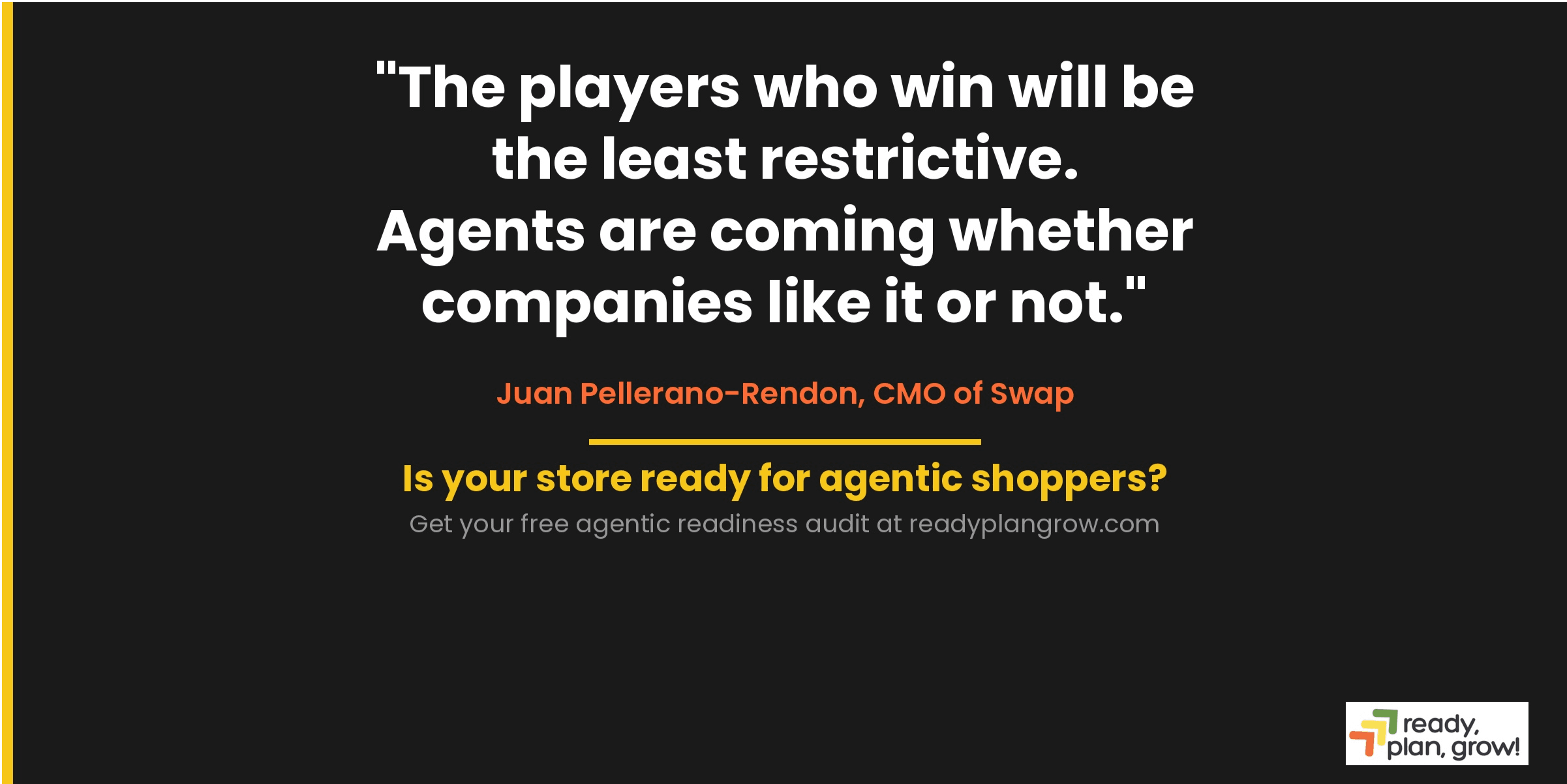
“The players who win will be the least restrictive. Agents are coming whether companies like it or not. Putting up barriers may feel protective in the short term, but it limits future opportunity.” – Juan Pellerano-Rendón, CMO of Swap
Part 1: What is Agentic Commerce?
Agentic commerce is when an AI-powered assistant, or “agent,” researches and makes a purchase entirely on behalf of a human. Your customer says to their phone, “Find me a waterproof, carbon-plate running shoe under $180 that can be delivered by Friday.
” The AI agent does the rest. It doesn’t scroll through your Instagram feed. It doesn’t read your clever tagline. It reads code. It looks for cold, hard, structured facts.
Think of it as the difference between a customer walking into your store versus sending a very smart, very fast, completely emotionless personal shopper on their behalf. That shopper doesn’t care about your brand story.
It cares about specifications, price, stock status, return policy, and delivery time. If your store can’t communicate those facts clearly and instantly, the shopper moves on. In milliseconds.
The Protocol Stack: WebMCP, UCP, ACP, and MCP Explained
There are a lot of acronyms flying around in this space. Here’s what you actually need to know:
WebMCP (Web Model Context Protocol) : Google’s new standard that lets your website talk directly to AI agents through the browser. Launched February 10, 2026. Allows agents to call structured functions on your site, like “add to cart” or “check stock.”
UCP (Universal Commerce Protocol) : Google’s standard for the full shopping journey from discovery through checkout. Co-developed with Shopify, Etsy, Wayfair, Target, Walmart, Visa, Mastercard, and Stripe.
ACP (Agentic Commerce Protocol) : Stripe and OpenAI’s open standard for programmatic commerce. Powers ChatGPT Instant Checkout. If you use Stripe, you can enable agentic payments by updating as little as one line of code.
MCP (Model Context Protocol) : Anthropic’s open standard that gives AI agents structured access to your store data. Shopify has a native MCP endpoint built in since Summer 2025.
The 4 Ways Your Store Fails AI Agents Right Now
After working with dozens of e-commerce stores on agentic readiness, the same four failure modes keep showing up:
Attribute Ambiguity: Product descriptions written in emotional, impressionistic language. “Feel the freedom of the open road” tells an agent nothing useful. Agents need facts, not feelings.
Inventory Opacity : Variant-level stock status not clearly exposed. An agent that can’t confirm a specific size or color is in stock will not recommend it. Full stop.
Schema Gaps : Missing or incomplete structured data markup means agents relying on web discovery can’t reliably understand what you sell. You’re invisible to them.
Checkout Friction : Multi-step or JavaScript-heavy checkout flows that require human interaction to complete. Agents need a clear, API-accessible path to purchase.
Part 2: Your 7-Action Agentic Commerce Sprint
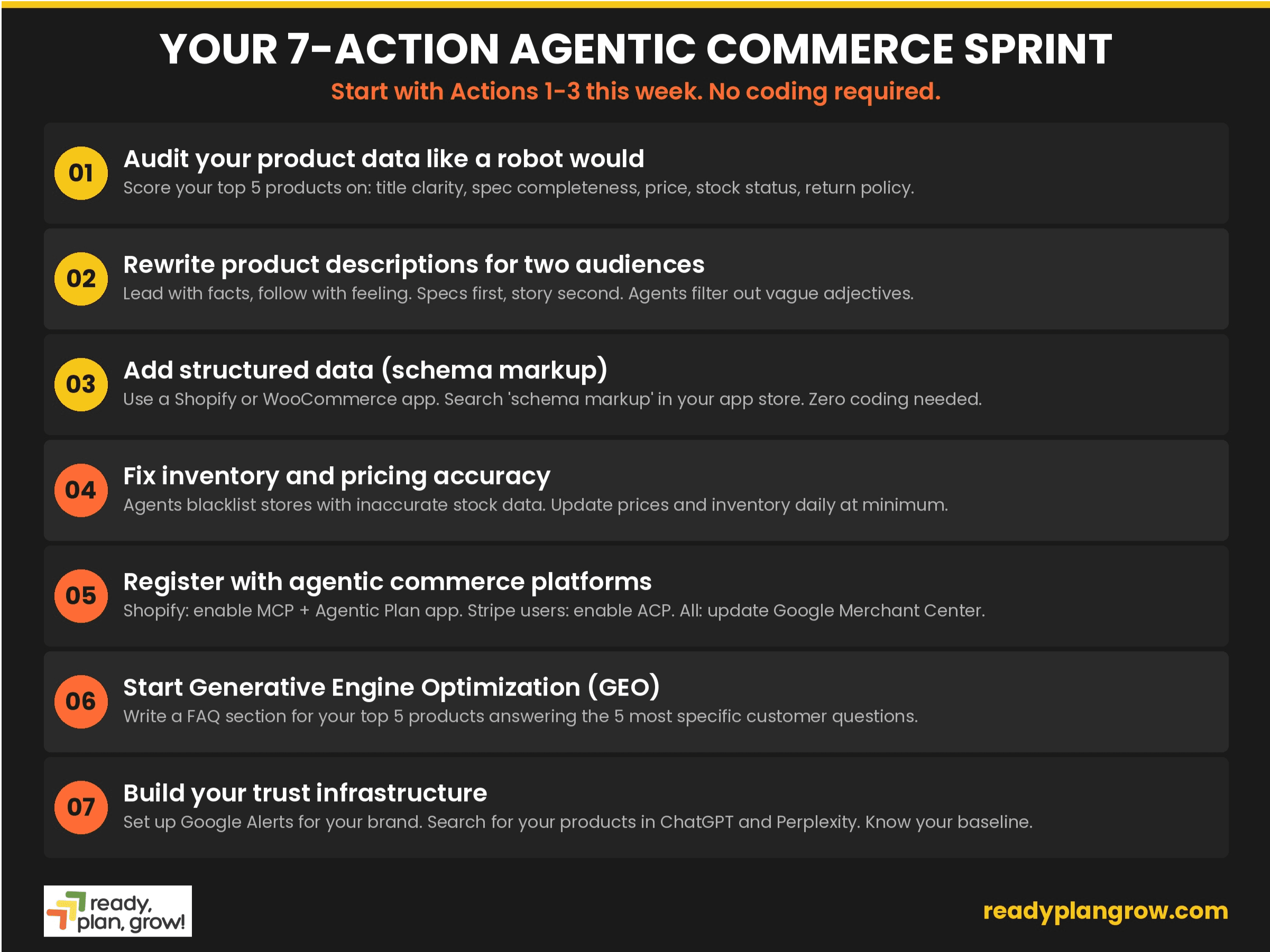
Enough context. Let’s talk about what you actually do. These are the real moves, in order of priority. Start with the first three this week.
Action 1: Audit your product data like a robot would
Pull up one of your best-selling product pages and look at it with fresh eyes. Not as a marketer. As a machine.
You’re looking for five things: a clear, descriptive product title; all key specifications listed (dimensions, weight, material, color, size); current price; real-time stock status; and shipping and return information.
Do this right now: Open your top 5 product pages. For each one, score it 1-5 on how clearly it communicates title clarity, spec completeness, price visibility, stock status, and policy clarity. Any score below 4 is a priority fix.
Action 2: Rewrite your product descriptions for two audiences
Your product descriptions need to serve both humans and AI agents simultaneously. The key is to lead with facts and follow with feeling. Agents filter out words like “amazing,” “best,” and “incredible.” They’re looking for objective nouns and verbs.
Don’t write: “Feel the freedom of the open road with our incredible cycling jersey!”
Do write: “Unisex cycling jersey, 150g merino wool, relaxed fit, sizes XS-3XL. Rated for 60-80F. Machine washable. Reflective rear panel for low-light visibility. Available in 4 colors.”
Action 3: Add structured data (schema markup) to your product pages
This is the single most important technical step you can take. Schema markup is code that you add to your website to tell AI agents and search engines exactly what your content is about.
If your website is the body, schema is the skeleton. Without it, agents can’t see what you’re selling.
If you’re on Shopify or WooCommerce, you don’t need to write any code. There are apps and plugins that handle this automatically. Search for “schema markup” or “structured data” in your platform’s app store.
You’re looking for something that generates Product, Offer, MerchantReturnPolicy, and AggregateRating schema in JSON-LD format.
Action 4: Fix your inventory and pricing accuracy
AI agents have a zero-tolerance policy for inaccurate data. If an agent attempts to buy a product that shows “In Stock” but is actually out of stock at the point of transaction, that agent will effectively blacklist your store for future queries.
Make sure your prices and stock levels are updated in real time, or at minimum, daily.
Action 5: Register with the major agentic commerce platforms
This is where you actually get your products in front of AI agents. Think of it like claiming your Google Business Profile, but for the agentic web.
Shopify users : Your store already has a native MCP endpoint at /api/mcp. To enable UCP, install the “Agentic Plan” app from the Shopify App Store.
Stripe users : Visit stripe.com/docs/agentic-commerce and enable agentic payments. You become eligible for ChatGPT Instant Checkout.
All merchants : Make sure your Google Merchant Center account is active and your product feed is current.
Action 6: Start your Generative Engine Optimization (GEO) strategy
Traditional SEO is evolving. You now need to optimize for AI-driven search, not just keyword-based search. This is called Generative Engine Optimization, or GEO.
AI agents don’t look for pages that “rank” for keywords. They look for pages that provide the best answer to a complex, specific query.
Do this right now: Write a FAQ section for your top 5 products. Answer the 5 most specific questions a customer might ask: “Is this waterproof?”, “What’s the return window?”, “Does this fit true to size?”, “What’s the exact material composition?”, “How long does shipping take?”
Action 7: Build your trust infrastructure and monitor your brand
In the age of agentic commerce, trust is the new SEO. AI agents are trained to evaluate trustworthiness based on structured data accuracy, third-party validation, and policy clarity.
Set up a Google Alert for your brand name and your top product names. Then open ChatGPT, Claude, or Perplexity and search for your products as if you were a customer. What comes up? What does the AI say about you? This is your baseline.
The window is open. But it won’t stay open forever.
We’re in the early innings of agentic commerce. The technology is live, the protocols are established, and the early adopters are already capturing market share. But the majority of small e-commerce businesses haven’t done anything about it yet. That’s actually good news for you.
You still have time to get ahead of this before it becomes table stakes.
The businesses that do the work now, that clean up their product data, implement structured markup, and register with the right platforms, will have a significant advantage when agentic commerce hits mainstream adoption in the second half of 2026.
The businesses that wait? They’ll be playing catch-up in a market where the rules have already been written without them.
This is Part 1 of a 3-part series from Ready, Plan, Grow! on agentic commerce.
What’s Next?
In Part 2, we’ll go deeper on Generative Engine Optimization and how to make your brand the one AI agents recommend. In Part 3, we’ll cover the trust and data infrastructure you need to protect your customer relationships in an agent-mediated world. We’re just getting started. Every week, we get better and find new ways to help. We’re excited to show you what we do next.
Want to see how we can help your business? Contact us or follow us on LinkedIn .
Sources and Citations
Forbes / Joe Toscano. “Google Ships WebMCP, The Browser-Based Backbone For The Agentic Web.” February 19, 2026.
Chrome for Developers. “WebMCP is available for early preview.” February 10, 2026.
McKinsey & Company. “The agentic commerce opportunity.” October 17, 2025.
Morgan Stanley. “Here Come the Shopping Bots.” December 8, 2025.
Harvard Business Review. “How Brands Can Adapt When AI Agents Do the Shopping.” February 19, 2026.
Google Blog. “New tech and tools for retailers to succeed in an agentic shopping era.” January 11, 2026.
BCG. “Agentic Commerce Is Redefining Retail.” October 6, 2025.
Stripe. “Developing an open standard for agentic commerce.” September 29, 2025.
MetaRouter. “Agentic Commerce Trends and Statistics for 2026.” 2026.
Retail Dive. “Retail’s risky AI commerce bet.” January 26, 2026.
Presta. “Agentic-First Shopify: The Practitioner’s Playbook.” February 18, 2026.
CJ Dropshipping. “How to Optimize Your Product Data for the 2026 AI Shopping Agents Shift.” February 6, 2026.
Forbes / Clara Ludmir. “Why Agentic Commerce Adoption Is Inevitable.” February 16, 2026.
READY, PLAN, GROW!